
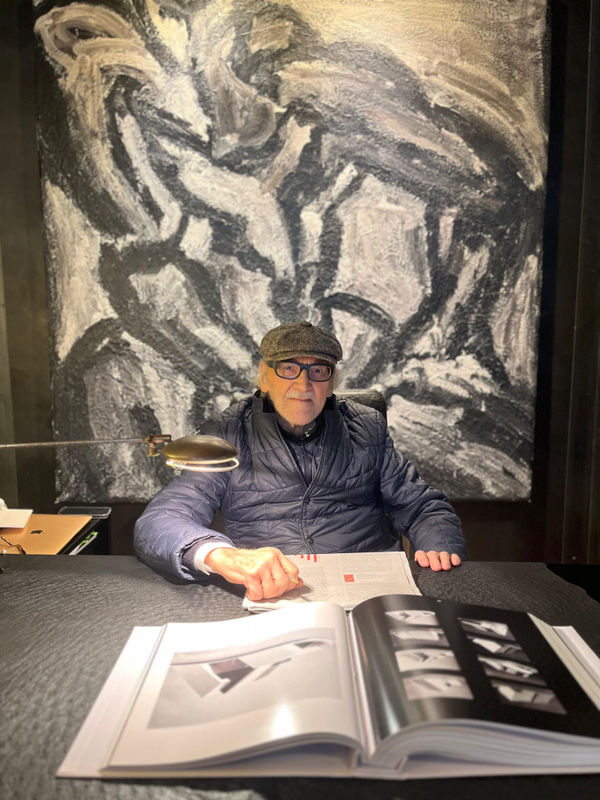
Carlo Eggermont (b. 1933, Ghent) is a Belgian painter whose practice is driven by an uncompromising search for what he calls the humane primate—a vision of the human being as both conscious and instinctual, shaped by culture yet fundamentally anchored in primal impulses. Painting, for Eggermont, is not a profession but a necessity: a language through which he excavates the psychological and physical forces that underpin human existence.
Over nearly five decades, Eggermont has developed a distinctly raw and layered pictorial approach. His canvases are built through repeated acts of covering and revealing, as if stripping away the “skins” of convention to expose a core state of being. This process results in dense surfaces that feel at once eroded and fertile—images that evoke earth, body, and memory, while resisting polished representation. His work is often dark in tone, yet its underlying impulse is deeply humanistic: a commitment to confronting the viewer with the complexities of desire, vulnerability, violence, tenderness, and love.
Eggermont’s figures and portraits are rarely naturalistic. Instead, they function as psychological presences, indebted to the existential intensity of artists such as Francis Bacon and Lucian Freud, and to the formal language of African ritual sculpture, which he has collected since early in his life. Sharp angles, bordering devices, and recurring motifs of fertility and embodiment reinforce the sense that the human subject cannot step outside the frame of its own condition.
While Eggermont’s oeuvre is predominantly restrained in colour, recent works incorporate unexpected chromatic interventions, expanding the emotional register of his practice. Whether figurative or geometrically inclined—echoing his parallel life in interior architecture—his paintings remain rooted in an urgent, timeless inquiry: what it means to be human beneath appearance, ideology, and history.