


Kengo Kuma
Complete Works 1988–Today. Art Edition ‘Yusuhara Community Market, Japan’, 2021
Signed heliogravure in portfolio, 37.4 x 29 cm; hardcover volume in handmade wooden slipcase, printed on two paper varieties, 30,8 x 39 cm, 4,71 kg, 460 pages
Edition of 200 plus 20 artist's proofs
Book numbered
Heliogravure signed by Kengo Kuma
Heliogravure signed by Kengo Kuma
9783836577144
Copyright The Artist
Photo: TASCHEN
Further images
-
(View a larger image of thumbnail 1
)

-
(View a larger image of thumbnail 2
)

-
(View a larger image of thumbnail 3
)

-
(View a larger image of thumbnail 4
)

-
(View a larger image of thumbnail 5
)

-
(View a larger image of thumbnail 6
)

-
(View a larger image of thumbnail 7
)

-
(View a larger image of thumbnail 8
)

-
(View a larger image of thumbnail 9
)

-
(View a larger image of thumbnail 10
)

-
(View a larger image of thumbnail 11
)
-
(View a larger image of thumbnail 12
)
-
(View a larger image of thumbnail 13
)

-
(View a larger image of thumbnail 14
)

-
(View a larger image of thumbnail 15
)

-
(View a larger image of thumbnail 16
)

-
(View a larger image of thumbnail 17
)

-
(View a larger image of thumbnail 18
)

-
(View a larger image of thumbnail 19
)

After Tadao Ando, Toyo Ito, and Fumihiko Maki, Kengo Kuma has breathed renewed vigor and lightness into Japanese architecture. Departing from the modernist skyscraper of the 20th century, Kuma traveled...
After Tadao Ando, Toyo Ito, and Fumihiko Maki, Kengo Kuma has breathed renewed vigor and lightness into Japanese architecture. Departing from the modernist skyscraper of the 20th century, Kuma traveled through his native Japan to develop a truly sustainable approach, translating local craftsmanship and resources into site-specific and timely buildings. Informed by tradition and with both feet firmly planted in the present, this “materialist” heralds a new tactile architecture marked by its engaging surfaces, innovative structures, and fluid forms, reconnecting people with the physicality of a house. Kuma’s objective, above all else, is “just to respect the culture and environment of the place where I am working.”
To this end, Kuma shaped the China Academy of Art’s Folk Art Museum partially from discarded roof tiles; created a Chapel out of birch and moss in Nagano; and worked with local craftsmen to sculpt the V&A Dundee into a twisted, layered reflection of the Scottish coastal cliffs. With an extraordinary sensitivity for space, light, and texture, Kuma reveals unexpected qualities in materials, finding the weightlessness of stone in Chokkura Plaza and the softness of aluminum in the thatched roof of the Yangcheng Lake Tourist Transportation Center.
More recently, the architect brought his philosophy to the Japan National Stadium built for the Olympic Games, originally planned for 2020. Kuma has said the stadium could be “the catalyst that will transform Tokyo back from a concrete city. I want it to set an example that will help alter the direction of Japanese architectural design.”
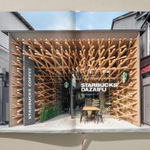
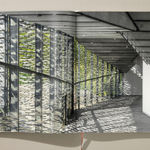
In this XXL-sized monograph with some 500 illustrations spanning photographs, sketches, and plans, Kuma guides us through his entire career to date, detailing milestone projects as well as ongoing works.
Art Edition (No. 1–200) with a heliogravure of a sketch of Yusuhara Community Market, Japan, signed by Kengo Kuma. The book and artwork come in a custom-built wooden slipcase designed by Kuma and produced by one of his partner workshops in Japan.
The artist: Kengo Kuma (born in Yokohama in 1954) attended the University of Tokyo and established Spatial Design Studio in 1979 after further studies at Columbia University, New York. In 1990, he founded Kengo Kuma & Associates. He is based in Tokyo and Paris, while he teaches at the Graduate School of Architecture at the University of Tokyo, where he also runs his own Laboratory, Kuma Lab.
The editor: Philip Jodidio studied art history and economics at Harvard and edited Connaissance des Arts for over 20 years. His TASCHEN books include the Homes for Our Time series and monographs on numerous major architects, including Norman Foster, Tadao Ando, Renzo Piano, Jean Nouvel, and Zaha Hadid.
To this end, Kuma shaped the China Academy of Art’s Folk Art Museum partially from discarded roof tiles; created a Chapel out of birch and moss in Nagano; and worked with local craftsmen to sculpt the V&A Dundee into a twisted, layered reflection of the Scottish coastal cliffs. With an extraordinary sensitivity for space, light, and texture, Kuma reveals unexpected qualities in materials, finding the weightlessness of stone in Chokkura Plaza and the softness of aluminum in the thatched roof of the Yangcheng Lake Tourist Transportation Center.
More recently, the architect brought his philosophy to the Japan National Stadium built for the Olympic Games, originally planned for 2020. Kuma has said the stadium could be “the catalyst that will transform Tokyo back from a concrete city. I want it to set an example that will help alter the direction of Japanese architectural design.”
In this XXL-sized monograph with some 500 illustrations spanning photographs, sketches, and plans, Kuma guides us through his entire career to date, detailing milestone projects as well as ongoing works.
Art Edition (No. 1–200) with a heliogravure of a sketch of Yusuhara Community Market, Japan, signed by Kengo Kuma. The book and artwork come in a custom-built wooden slipcase designed by Kuma and produced by one of his partner workshops in Japan.
The artist: Kengo Kuma (born in Yokohama in 1954) attended the University of Tokyo and established Spatial Design Studio in 1979 after further studies at Columbia University, New York. In 1990, he founded Kengo Kuma & Associates. He is based in Tokyo and Paris, while he teaches at the Graduate School of Architecture at the University of Tokyo, where he also runs his own Laboratory, Kuma Lab.
The editor: Philip Jodidio studied art history and economics at Harvard and edited Connaissance des Arts for over 20 years. His TASCHEN books include the Homes for Our Time series and monographs on numerous major architects, including Norman Foster, Tadao Ando, Renzo Piano, Jean Nouvel, and Zaha Hadid.